My research centers on two directions: the prosody–pragmatics interface and phonetic variation in trill consonants.
01
Prosody & Pragmatics Interface
Examining how prosody is recruited and interpreted as a cognitive resource by language users, and how it interacts with pragmatic meaning—analyzing, from a cross-linguistic and cross-dialectal perspective, how prosodic strategies shape utterance meaning and information structure.
More details
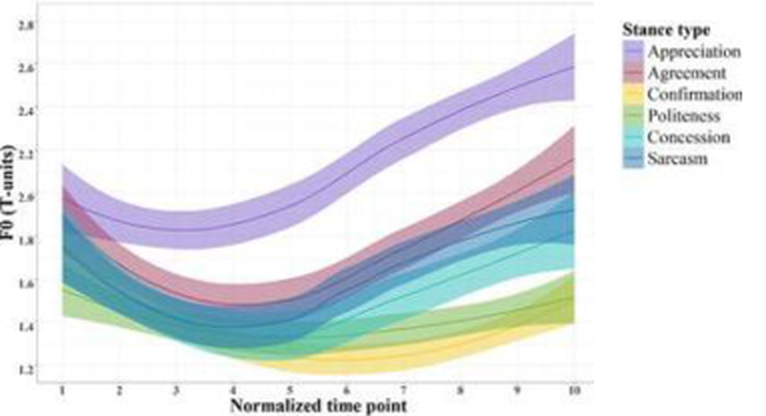
F0 contours of hao 好 across six stance types
02
Trill Consonants
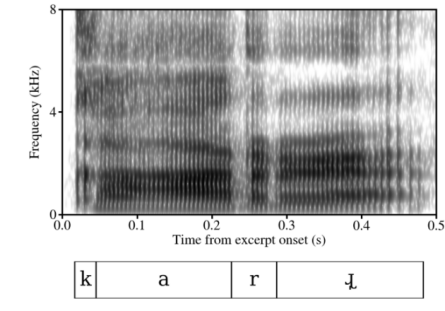
Studying the production and phonetic variation of trills in languages such as the Tongtai dialects: trill production is highly unstable, tends to occur after low vowels, and shows intergenerational and gender differences; I currently use Bayesian modeling to analyze how multiple factors jointly shape trill realization.
More details
Spectrogram of a trill [r]
Publications
发表
已收录的论文与会议报告。点「显示更多」可查看全部。
ISAPh 2026 · PROCEEDINGS
Pitch Prominence of Focus in Japanese: Trained vs. Untrained Speakers
Makino, Toko · Yamane, Noriko · Wu, Siyu
Proceedings of the International Symposium on Applied Phonetics (ISAPh 2026)
ISAPh 2026 · PRESENTATION
Prosodic Features of Chinese Negative Response Word bu
Wu, Siyu · Yamane, Noriko
International Symposium on Applied Phonetics (ISAPh 2026)
DSIE 2024 · PROCEEDINGS
Prosodic Features of Stance-Taking in Tonal Languages: Examples from Mandarin Interjection hao
公猫,中华田园猫,2026 年 1 月 12 日出生。汉语里的「橘」和 Ju 谐音,因此取名 Juliet。
Gallery
照片墙
生活与研究的影像记录。
Research · 01
Prosody & Pragmatics Interface
My research is situated at the interface between prosody and pragmatics. Two broad traditions have emerged in the study of pitch patterns: one treats pitch as a phonological object assigned grammatical meanings within formal phonology; the other embeds pitch in conversation, treating prosodic variation as a situated conversational resource within Conversation Analysis. My work proceeds along a third route—adopting a quantitative, experimental-phonetic methodology to uncover empirically how prosodic patterns, above all pitch, participate in conversational interpretation, while bringing the tools of formal pragmatics to bear on response particles and interjective stance markers, so that phonetic findings and formal accounts inform each other.
The work forms a coherent experimental series on Mandarin monosyllabic pragmatic particles: first, the interjection hao 好 and how prosody encodes stance-taking in a tonal language; then the negative response word bu 不, following a theoretical-and-experimental structure with the full formal-pragmatic derivations of particle interchangeability.
Prosodic Encoding of Stance-Taking: The Mandarin Interjection hao 好
Research Question
Stance—attitudes and opinions about the topic of discussion—is manifested in various aspects of verbal communication, and one of the most important things we do with words is to take a stance. Previous research on the phonetics of stance-taking has predominantly focused on non-tonal languages; comparatively little attention has been paid to tonal languages. This study examines the prosodic features of stance-taking in hao, a Mandarin secondary interjection that is lexically positive but capable of expressing a wide range of stances. The study addresses two research questions: (i) What are the acoustic-prosodic features of hao across its six stance types? and (ii) What are the similarities and differences between the phonetic realization of stance-taking in non-tonal and tonal languages, by the examples of English and Mandarin?
Stance Framework
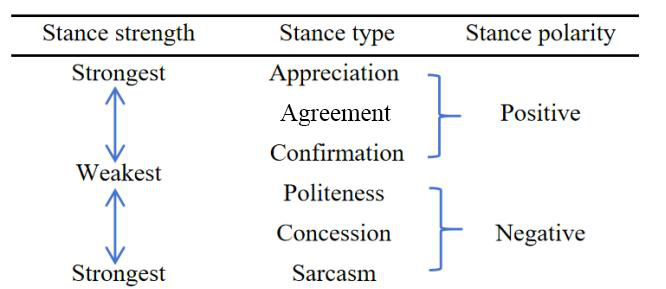
Theoretically, the interjection hao encompasses six stance types: Appreciation, Agreement, Confirmation, Politeness, Concession, and Sarcasm. Appreciation, Agreement, and Confirmation represent positive stance, whereas Politeness, Concession, and Sarcasm denote negative stance. The order of stance strength is: Appreciation > Agreement > Confirmation, and Sarcasm > Concession > Politeness. Note that stance strength here is defined across stance types, rather than within a single type.
Figure 1. Theoretical framework of hao's stance-taking (stance strength, stance type, and stance polarity).
Method
Fifteen native Mandarin speakers (9 males, 6 females, aged 21–25) participated in a controlled production experiment. Eighteen scenarios (three per stance type), revised from the BCC and CCL corpora, were adapted into dialogues in which hao always occurs in utterance-initial position. Recordings were digitized at 44.1 kHz / 16-bit in Praat. Mean F0, F0 range, mean intensity, and duration were extracted; F0 and intensity were sampled from the vowel at ten equidistant points, and duration from the syllable. All F0 values, including point data, were transformed into T-values for cross-speaker normalization appropriate to tonal data: T = ((log(TargetHz) − log(min)) / (log(max) − log(min))) × 5. Intensity was scaled to 70 dB. Time-normalized F0 and intensity contours were extracted using ProsodyPro. Point data across the six stance types were analysed in R with linear mixed-effects models (LMMs, lmerTest), with stance type and gender as fixed effects and speaker as random effect; Tukey post hoc tests were conducted, and contours were drawn with 95% confidence intervals, where non-overlap indicates a significant difference.
Findings · Point Data
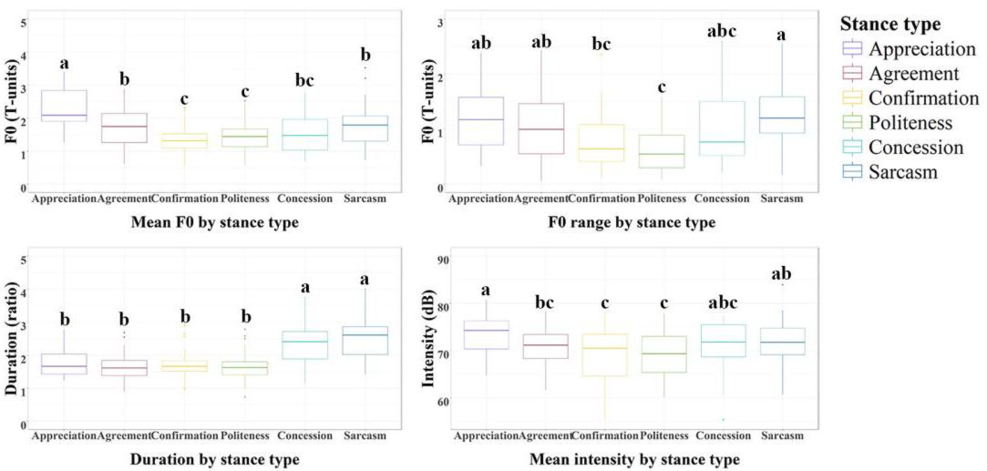
The LMMs revealed systematic prosodic marking for stance polarity and stance strength. For mean F0, there was a significant main effect of stance type [F(5, 242) = 19.07, p < 0.001]: Appreciation was significantly higher than the other five types, Agreement was higher than Confirmation and Politeness, and Sarcasm was higher than Confirmation and Politeness. For F0 range [F(5, 242) = 6.350, p < 0.001], Confirmation and Politeness had narrower ranges than Appreciation, Agreement, and Sarcasm. For duration [F(5, 242) = 25.998, p < 0.001], Concession and Sarcasm were robustly marked by syllable lengthening. For mean intensity [F(5, 242) = 8.559, p < 0.001], Appreciation and Sarcasm were marked by increased intensity. Overall, Appreciation, Agreement, Concession, and Sarcasm are prosodically marked forms, while Confirmation and Politeness are unmarked.
Figure 2. Statistical comparisons of mean F0, F0 range, duration, and mean intensity across the six stance types (with group-separation letters).
Findings · F0 Contours
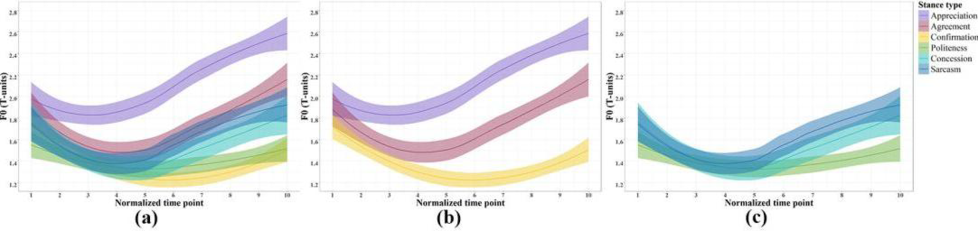
Examination of the time-normalized F0 contours (Figure 3) reveals tone variation driven by emotional factors and pragmaticalization. All contours are dipping in shape, sharing an initial decline followed by a rise, but with notable differences. The positive stances Appreciation and Agreement exhibit brief-to-moderate declines followed by substantial rises, with Appreciation consistently higher in global F0. The negative stances Concession and Sarcasm show approximately congruent dipping contours, with Sarcasm's inflection point occurring slightly earlier and its endpoint slightly higher. By contrast, the pragmaticalized neutral uses Confirmation and Politeness show compressed, low-flat tonal shapes: Confirmation's contour declines dramatically with the inflection point furthest to the right and a final rise that remains much lower than other types, while Politeness stays relatively flat with a slight dip and a gradual, steady rise that ends at the same location as Confirmation. A canonical full L (third) tone exhibits a dipping contour (214) in isolation but is shortened to low and flat in natural speech; here, the flattened contours of Confirmation and Politeness reflect phonological reduction associated with pragmaticalization.
Figure 3. F0 contours of hao: (a) by stance type; (b) positive stance; (c) negative stance.
Findings · Intensity Contours
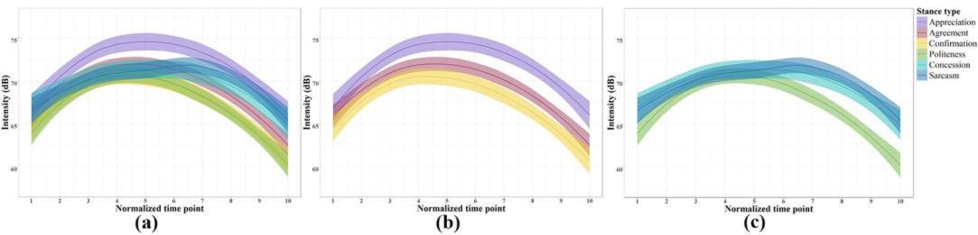
The intensity contours (Figure 4) show that all stance types reach their peak around the middle of the utterance, yielding dome-shaped trajectories—except for Sarcasm. Among the positive stances, Appreciation shows the highest intensity throughout, Agreement occupies a middle position, and Confirmation has the lowest intensity, with its contour completely overlapped with Politeness. The pattern of Sarcasm is unique: it exhibits the latest and highest maximum intensity location. In its initial segment it grows like the other categories until roughly normalized time points 5–6, then ascends more precipitously than Concession to a secondary peak while the other contours begin their descent. Thus, although Concession and Sarcasm are statistically indistinguishable in point data and have highly similar F0 trajectories, their intensity contours differentiate them in detail, with Sarcasm's delayed, late intensity peak serving as a critical distinguishing cue.
Figure 4. Intensity contours of hao: (a) by stance type; (b) positive stance; (c) negative stance.
A Neutral Stance
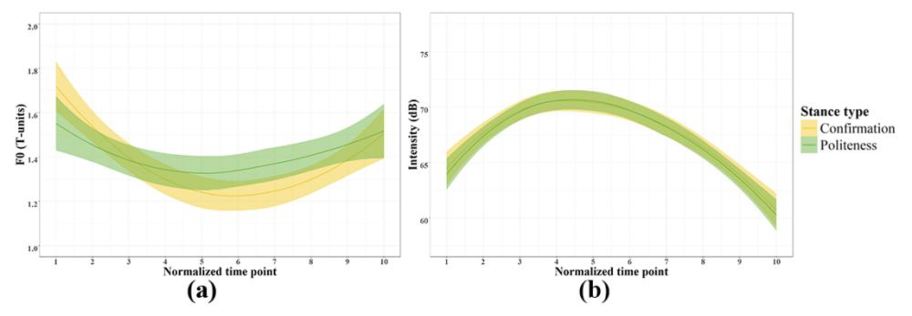
Because Confirmation and Politeness fail to achieve sufficient elevation in their F0 rises, their contours do not retain the canonical third-tone final rise, exhibiting instead a low, flat shape. The source of this tone variation appears semantic: Appreciation and Agreement maintain a close relationship with the original positive meaning; Concession and Sarcasm convey opposite meanings through prosodic lengthening; and Confirmation and Politeness are more susceptible to semantic reduction, functioning primarily as formulaic sequences. Pragmaticalization is typically accompanied by phonological reduction, manifested here as lower main pitch and reduced F0 targets for final rises. The nearly identical contours of Confirmation and Politeness (Figure 5), together with the low recognition accuracy of Politeness, provide substantial evidence for a neutral stance that previous studies had not considered. Stances are therefore classified as positive, neutral, and negative.
Figure 5. Contours of the neutral stance: (a) F0 contours of Confirmation and Politeness; (b) intensity contours of Confirmation and Politeness.
Cross-Linguistic Discussion
The findings highlight typological divergence between tonal and non-tonal languages. English primarily uses duration and intensity to distinguish stance types, with F0 indicating stance strength and polarity; by contrast, Mandarin employs F0 to distinguish fine-grained stance types, with F0 serving as a primary acoustic parameter alongside duration. The languages also differ in their use of duration: English speakers mark positive stance by lengthening, whereas in Mandarin lengthening exclusively signals negative stance. Given that hao is semantically positive, it cannot express a negative stance without prosodic or contextual hints. Lengthening therefore functions as a type of markedness that provides the pragmatic hints necessary in the ostensive-inferential process, either intensifying or reversing the literal meaning. These findings deepen our understanding of how tonal languages prosodically encode stance-taking and provide theoretical insights for identifying stance information in natural speech.
Study 02
Prosody and Pragmatics of the Negative Response Word bu 不
Interchangeability of Polar Particles
Whether a speaker uses yes or no in response to a polar question (PQ) depends on one's real intentions. In responding to a positive polar question such as (1), yes confirms arrival while no denies it, and only the expected pairings are felicitous.
(1)A: Are you coming to the party?
a. B: Yes, I am. b. B: #No, I am.
c. B: #Yes, I am not. d. B: No, I am not.
One notable property of polar particles, however, is that it is free to use positive or negative polar particles when answering negative polar questions, as in (2).
(2)A: Are you not coming to the party?
a. B: Yes, I am. b. B: No, I am.
c. B: Yes, I am not. d. B: No, I am not.
Negative questions are only felicitous in the presence of contextual evidence for the negative answer. Answers such as (2b) are called double negation (DN) interpretations, and answers such as (2c) negative concord (NC) interpretations. This phenomenon is often called interchangeability. Previous research has primarily focused on English, with limited attention to Chinese. Consider (3):
(3)A: Ta bu lai-le-ma? ‘Is he not coming?’
a. B: #Dui, lai-ne. ‘Yes, he is coming.’
b. B: Bu, lai-ne. ‘No, he is coming.’
c. B: Dui, bu lai. ‘Yes, he is not coming.’
d. B: Bu, bu lai. ‘No, he is not coming.’
It can be seen that the combination of a positive polar particle with a positive answer is infelicitous in Chinese, in contrast to English, where such responses are perfectly natural. People also prefer the DN interpretation over the NC interpretation in Chinese, again contrasting with English, which prefers NC over DN. This may highlight a language-specific restriction and urges us to revise existing accounts of interchangeability.
Prior Formal Accounts of Interchangeability
Several theorists have sought to provide overarching explanations for interchangeability, attributing it to different formal mechanisms. I review these before presenting my own revision.
Krifka (2013): propositional anaphora. Krifka argues that negative sentences introduce multiple antecedents for yes and no to pick up. Yes and no are propositional anaphora that stand in semantically for entire speech acts (the category Krifka calls ActP). A positive polar question makes available a single discourse referent d anchored to the TP, as in (5); in a negative polar question, two antecedents become available—d anchored to the embedded TP and d′ anchored to the NegP, as in (6).
(5)Is Jane coming?
simplified LF: [TP Jane is coming] ↦ d
a. Yes = assert (d) [meaning: Jane is coming]
b. No = assert (¬d) [meaning: Jane is not coming]
(6)Is Jane not coming?
simplified LF: [NegP not [TP Jane is coming]] ↦ d′ ↦ d
a. (i) Yes = assert (d) [meaning: Jane is coming]
(ii) No = assert (¬d) [meaning: Jane is not coming]
b. (i) Yes = assert (d′) [meaning: Jane is not coming]
(ii) No = assert (¬d′) [meaning: Jane is coming]
In (6a), yes asserts d and no asserts its negation; in (6b), yes asserts d′ (equivalent to ¬d) and no asserts its negation. Under this analysis, interchangeability in negative contexts follows from the availability of two discourse referents.
Kramer and Rawlins (2009). Building on Laka (1990), K&R treat yes and no as adverbs in the specifier of a functional polarity head in the left periphery, with bare particles analysed as fragment answers. The use of no is constrained in that it can only occur if the following, optionally elided, sentence contains negation: no carries an uninterpretable negative feature (uNeg) that must enter a negative concord chain with an interpretable negative feature (iNeg). Yes does not contribute any features and is unconstrained by the polarity of the following sentence, as shown in (7) and (8).
(7)/(8)A: Is Jane not[iNeg] coming?
a. B: [PolP No[uNeg] [She is not[iNeg] coming]]
b. B: [PolP Yes [TP She is not[iNeg] coming]]
Both particles are therefore predicted to be acceptable in negative responses to negative questions. One issue is that this account only deals with one half of the interchangeability phenomenon, negative answers; and because yes imposes no syntactic requirement, nothing stops yes from appearing in negative responses to positive questions, contrary to fact (10).
(10)A: Is Jane coming?
a. B: [PolP Yes [TP She is not[iNeg] coming]]
Holmberg (2013; 2016). Like K&R, Holmberg treats yes and no as specifiers of a functional projection, and analyses bare particles as fragment answers. Yes and no are operators that assign positive and negative values, respectively, to the polarity head of their complement. The polarity head contains a polarity variable that can take one of three values: Positive [+], negative [−], and open [±]. Positive polar questions have open polarity (11). Holmberg locates the source of interchangeability in a structural ambiguity: negation in English attaches at two different heights—high negation between TP and vP, and low negation adjoined to vP/VP (12).
(11)A: Is[±] Jane coming?
a. B: [FocP Yes [PolP [+] [TP She is coming]]]
b. B: [FocP No [PolP [−] [TP She is not coming]]]
(12)Structure for ‘Is Jane not coming?’
a. A: Is[±] Jane coming? (low-negation PQ)
(i) B: [FocP Yes [PolP [+] [TP She is [vP not coming]]]]
(ii) B: [FocP No [PolP [−] [TP She is [vP not coming]]]]
b. A: Is Jane not[−] coming? (high-negation PQ)
(i) B: [FocP Yes [PolP [+] [TP She is coming]]]
(ii) B: [FocP No [PolP [−] [TP She is not coming]]]
The structural ambiguity of the two attachment heights of negation is what makes yes and no interchangeable in negative contexts in this account.
Roelofsen and Farkas (2015). Unlike the accounts above, R&F attribute interchangeability to the ability of polarity particles to encode two types of features: absolute polarity features ([+] and [−]) and relative discourse features ([agree] and [reverse]). Yes is capable of realizing [+] or [agree]; no is capable of realizing [−] or [reverse]. Only one of the features it realizes needs to be present to license the particle. The system is demonstrated in (13) and (14).
(13)A: Petra passed the test.
a. B: Yes / #No, she did. [agree, +]
b. B: #Yes / No, she didn't. [reverse, −]
(14)A: Petra didn't pass the test.
a. B: Yes / No, she didn't. [agree, −]
b. B: Yes / No, she DID. [reverse, +]
In response to negative sentences, the two valid responses in (14) contain features that can be realized by either particle, so either particle can be used in either response—this is how R&F explain interchangeability.
A Revised Account with Chinese Materials
Considering the Chinese facts in (3), there is reason to doubt the effectiveness of a purely semantic or syntactic analysis. It is important to include presuppositions in the analysis. In (15), when the presupposition is not coming, the acceptability of the responses is the same as for simple questions, meaning that it is the structure of negative questions, not the presuppositions, that causes interchangeability.
(15)A: Ta hai lai-ma? ‘Is he still coming?’ (speaker presupposes he would not come)
a. B: Dui, lai-ne. ‘Yes, he is coming.’
b. B: #Bu, lai-ne. ‘No, he is coming.’
c. B: #Dui, bu lai. ‘Yes, he is not coming.’
d. B: Bu, bu lai. ‘No, he is not coming.’
Nevertheless, presuppositions play a key role in analysing interchangeability. My revised analysis is given in (16). I suppose that when the response agrees ([+]) with the questioner's presuppositions, the language unit being processed could be the TP or NegP in Krifka's (2013) sense; positive or negative particles can only be used to give values to TP or NegP, not to the presuppositions. If the response disagrees ([−]) with the questioner's presuppositions, the language unit being processed could only be NegP.
(16)Is Jane not coming?
simplified LF: [NegP not [TP Jane is coming]] ↦ d′ ↦ d
a. (i) Yes, Jane is coming. [−] (Yes is used to affirm with the presupposition)
(ii) No, Jane is coming. [−] (No is used to negate NegP)
b. (i) Yes, Jane is not coming. [+] (Yes is used to affirm NegP)
(ii) No, Jane is not coming. [+] (No is used to negate TP)
Crucially, since in English yes is more pragmatically interpretable, it can be used to give values to presuppositions; whereas in Chinese dui and bu are not interchangeable. If dui is changed to kending-a 肯定啊 (‘of course’), the particles become interchangeable, as in (17). This evidence tells us that interchangeability is not merely a pragmatic or syntactic issue, but somehow needs insights from lexical semantics.
(17)A: Ta bu lai-le-ma? ‘Is he not coming?’
a. B: Kending-a, lai-a. ‘Of course, he is coming.’
b. B: Kending-a, bu lai-le-a. ‘Of course, he is not coming.’
Despite these differences in interchangeability being attributable to lexical semantics, DN, NC, and SN forms also exist in Chinese. It is still unclear whether they have distinct prosodic features. The next part of this research examines whether these different types of responses are expressed with different prosodies in Chinese, helping to explain how speakers use prosody to convey different meanings when replying to questions.
Method
To obtain the prosodic features of each interpretation, the experiment set a control group—simple negation (SN), the response to simple polar questions. Twenty native Mandarin speakers (10 males, 10 females, aged 18–25) from Jiangsu Province, China, participated; all were screened for speech and hearing disorders and mental health issues, and were verified right-handed. Each stimulus combined a scenario, a conversational prompt, and a targeted single-word response, designed to evoke specific interpretations within realistic contexts. Participants were instructed to pause at a designated point (‘___’) so that acoustic analysis could concentrate specifically on the polar particle, minimizing extraneous prosodic influence. Six items were constructed per condition (SN, NC, DN). Recordings were collected with an AKG 3000 condenser microphone (44.1 kHz / 16-bit) and presented via E-Prime 2; in total, 360 target words (18 items × 20 participants) were recorded. F0 and intensity data were derived from vowels, duration from syllables; F0 was sampled at ten equidistant points, converted to T-values, duration normalized to each speaker's mean, and intensity normalized to 70 dB. Point data were analysed with LMMs with Type (SN/NC/DN) and gender as fixed effects and speaker as random effect; F0 contours were drawn with ggplot2 with 95% confidence intervals.
Findings · Point Data
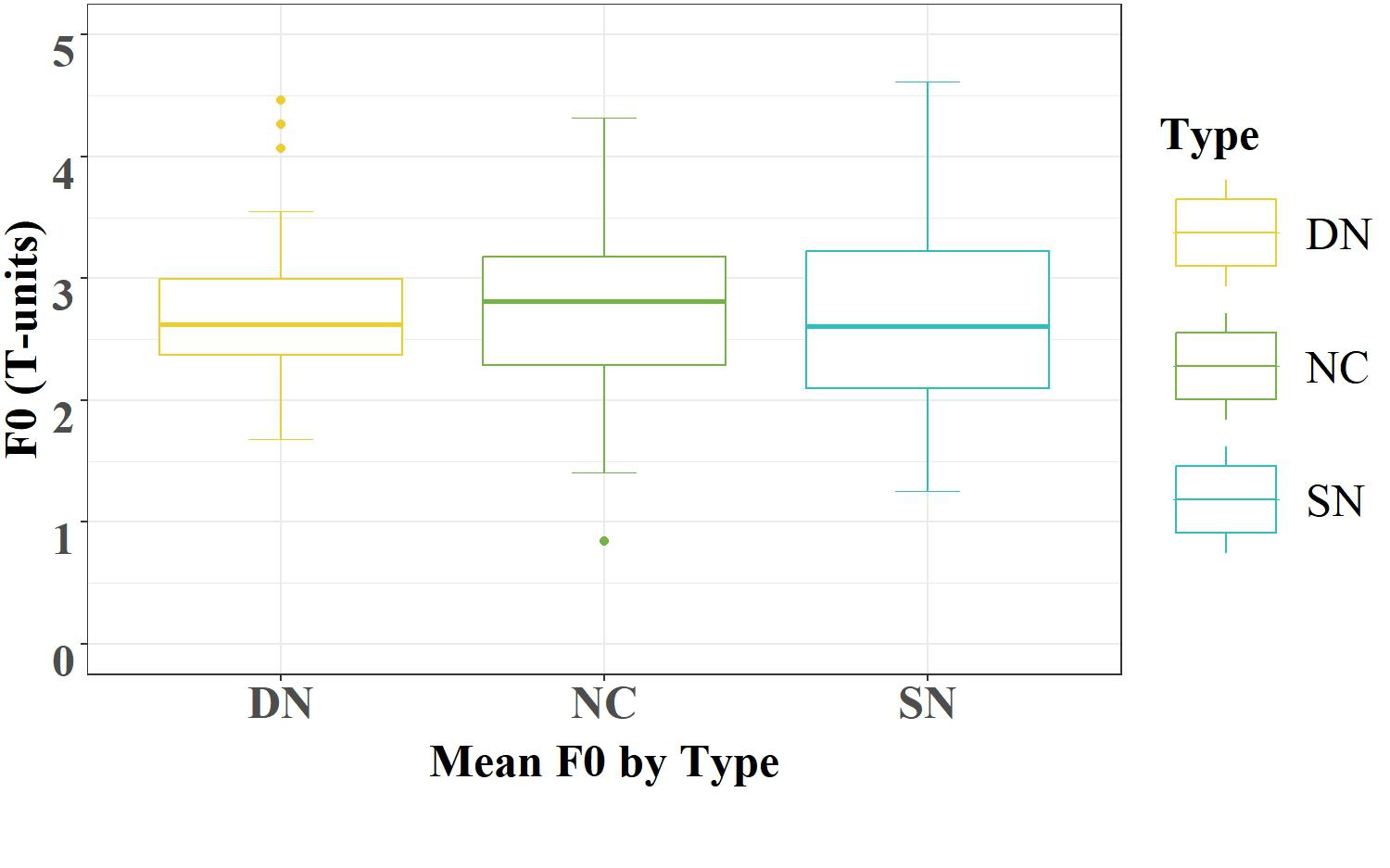
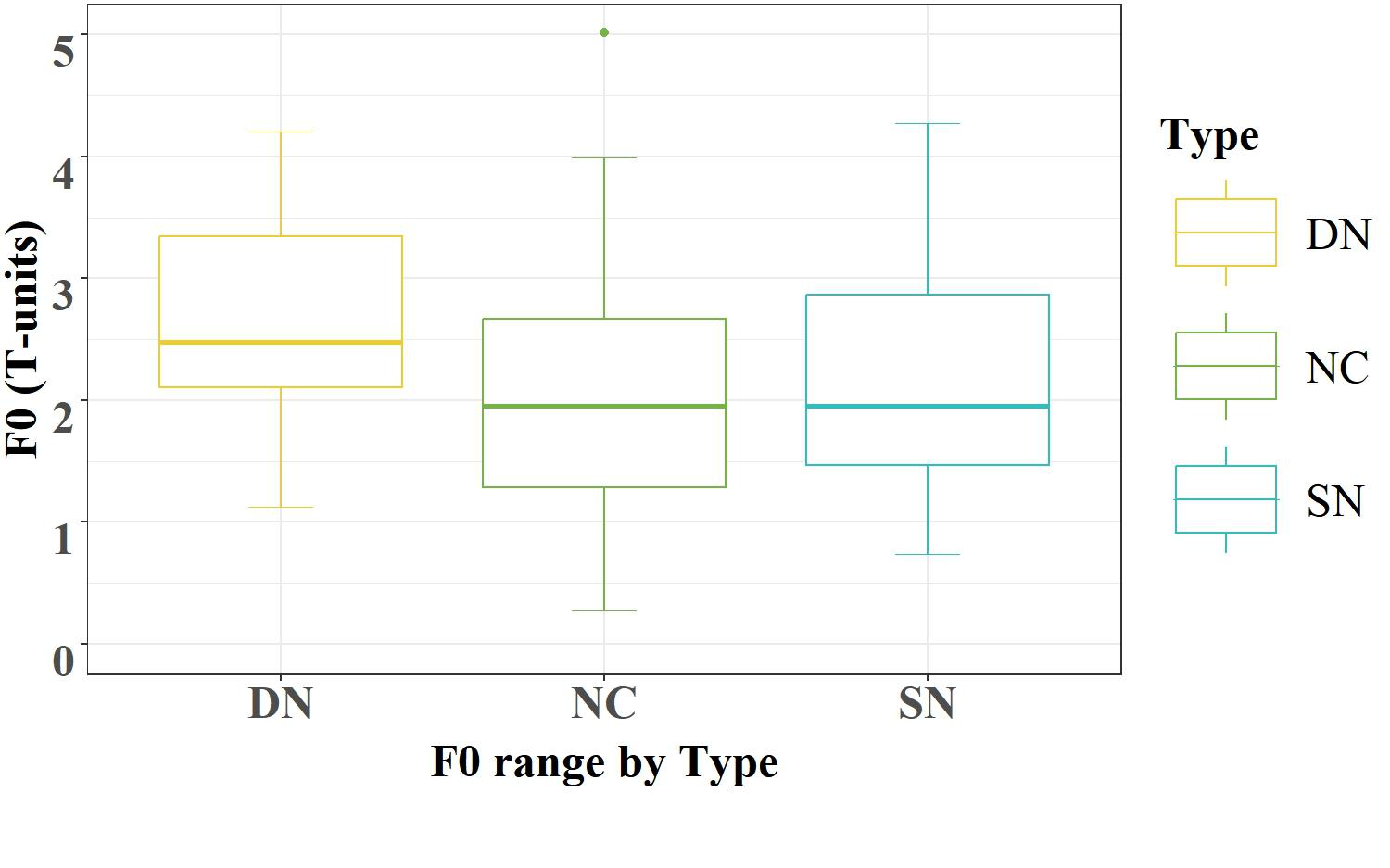
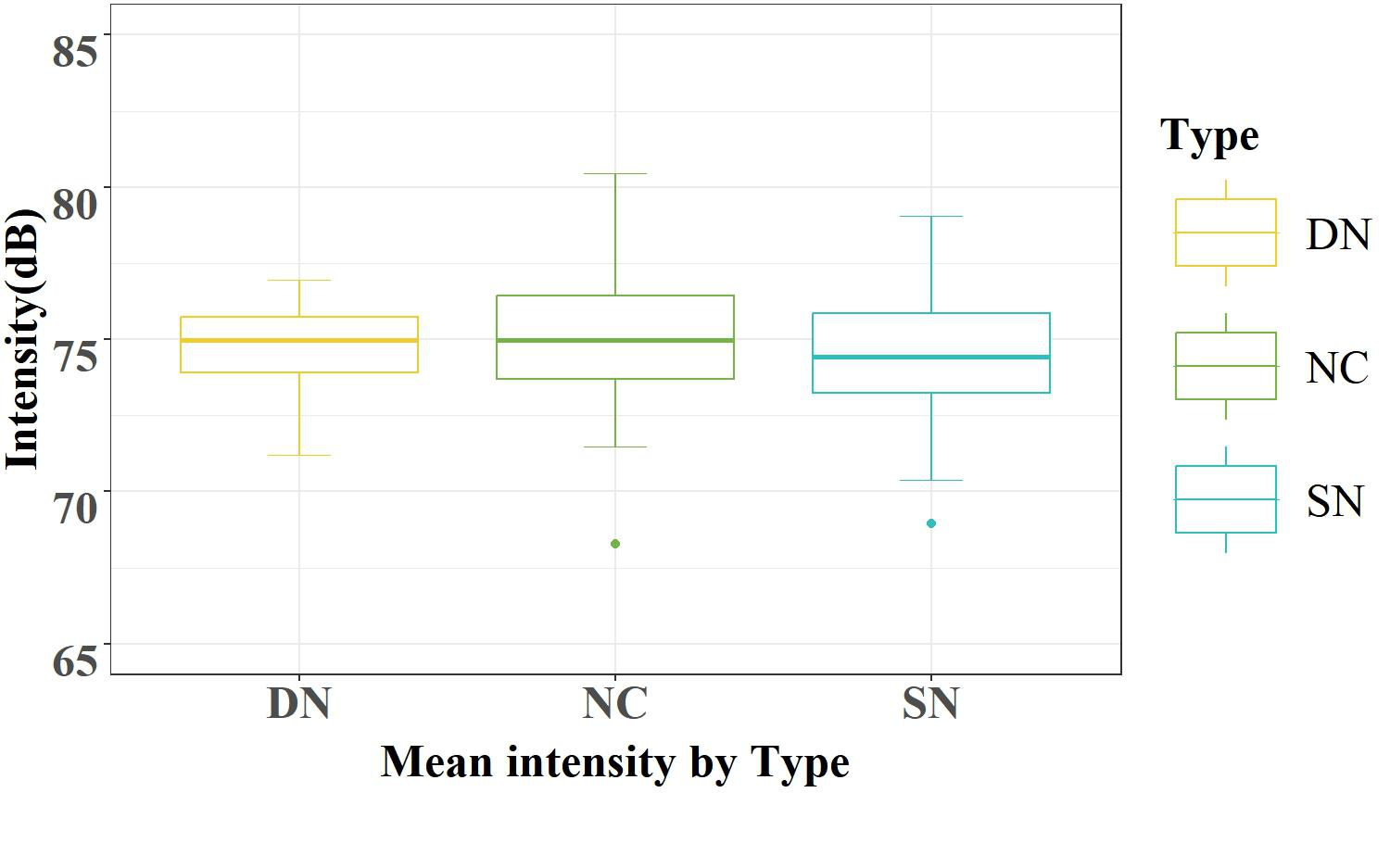
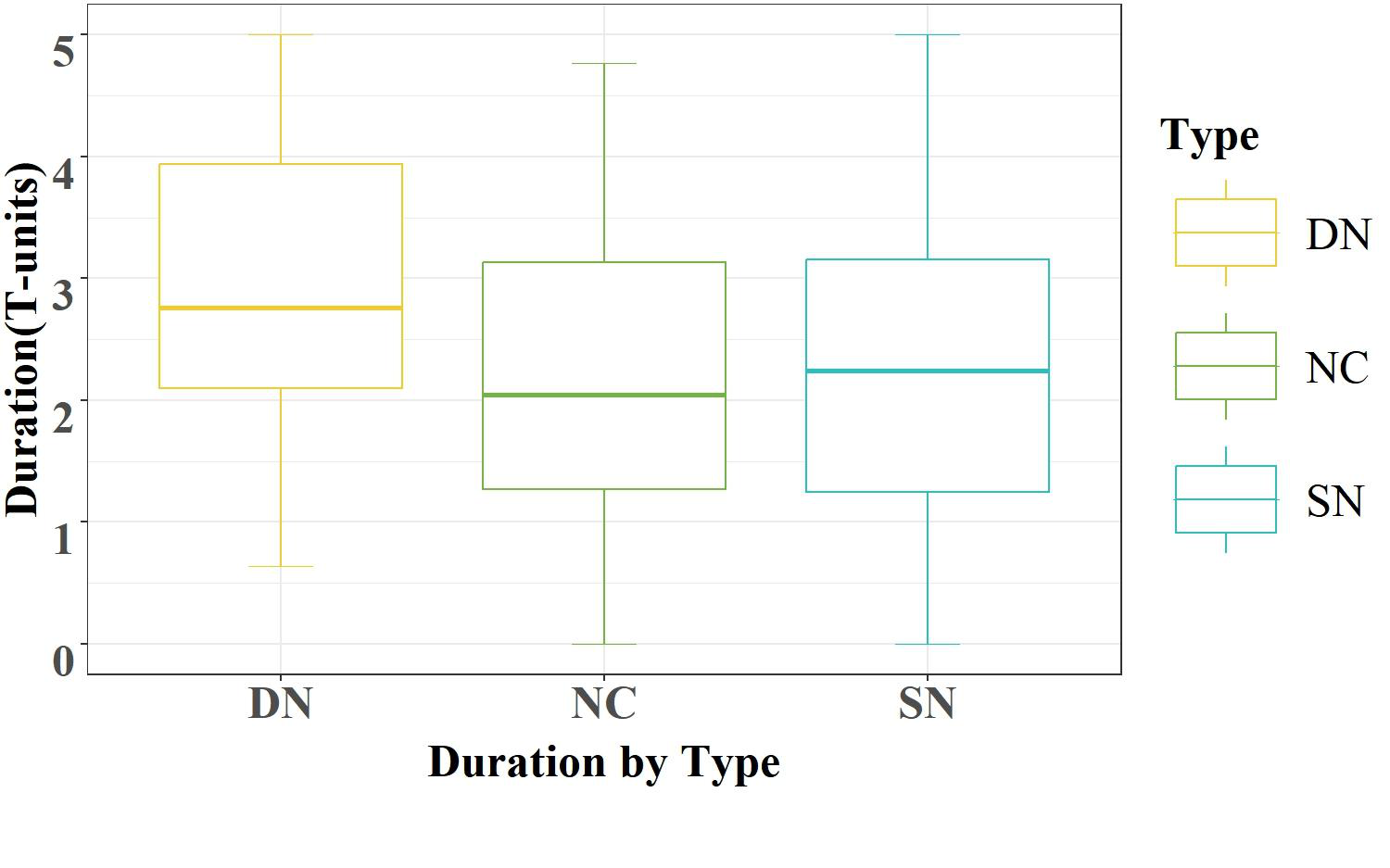
For mean F0, the LMM showed no significant main effect of Type [F(2, 360) = 0.150, p = 0.861], but a significant main effect of gender (p = 0.011). For F0 range, there was a significant main effect [F(2, 360) = 23.142, p < 0.001]: DN had a broader F0 range (T-units) than NC and SN [β(DN−NC) = 0.660, t = 5.898, p < 0.001; β(DN−SN) = 0.624, t = 5.563, p < 0.001]. For mean intensity [F(2, 360) = 4.253, p = 0.018], SN was lower than DN and NC [β(SN−DN) = −0.587 dB, p = 0.039; β(SN−NC) = −0.670 dB, p = 0.018]. For duration [F(2, 360) = 7.173, p = 0.002], DN had a longer duration than NC and SN [β(DN−SN) = 0.631, p = 0.003; β(DN−NC) = 0.692, p = 0.003]. Taken together, the marked reading DN is characterized by a broader F0 range, higher intensity, and longer duration, whereas SN—and, largely, NC—show more neutral prosodic profiles. The four point-data comparisons are shown in Figures 6–9.
Figure 6. Statistical comparison of mean F0 across SN, NC, and DN.Figure 7. Statistical comparison of F0 range across SN, NC, and DN.Figure 8. Statistical comparison of mean intensity across SN, NC, and DN.Figure 9. Statistical comparison of duration across SN, NC, and DN.
Findings · F0 Contours
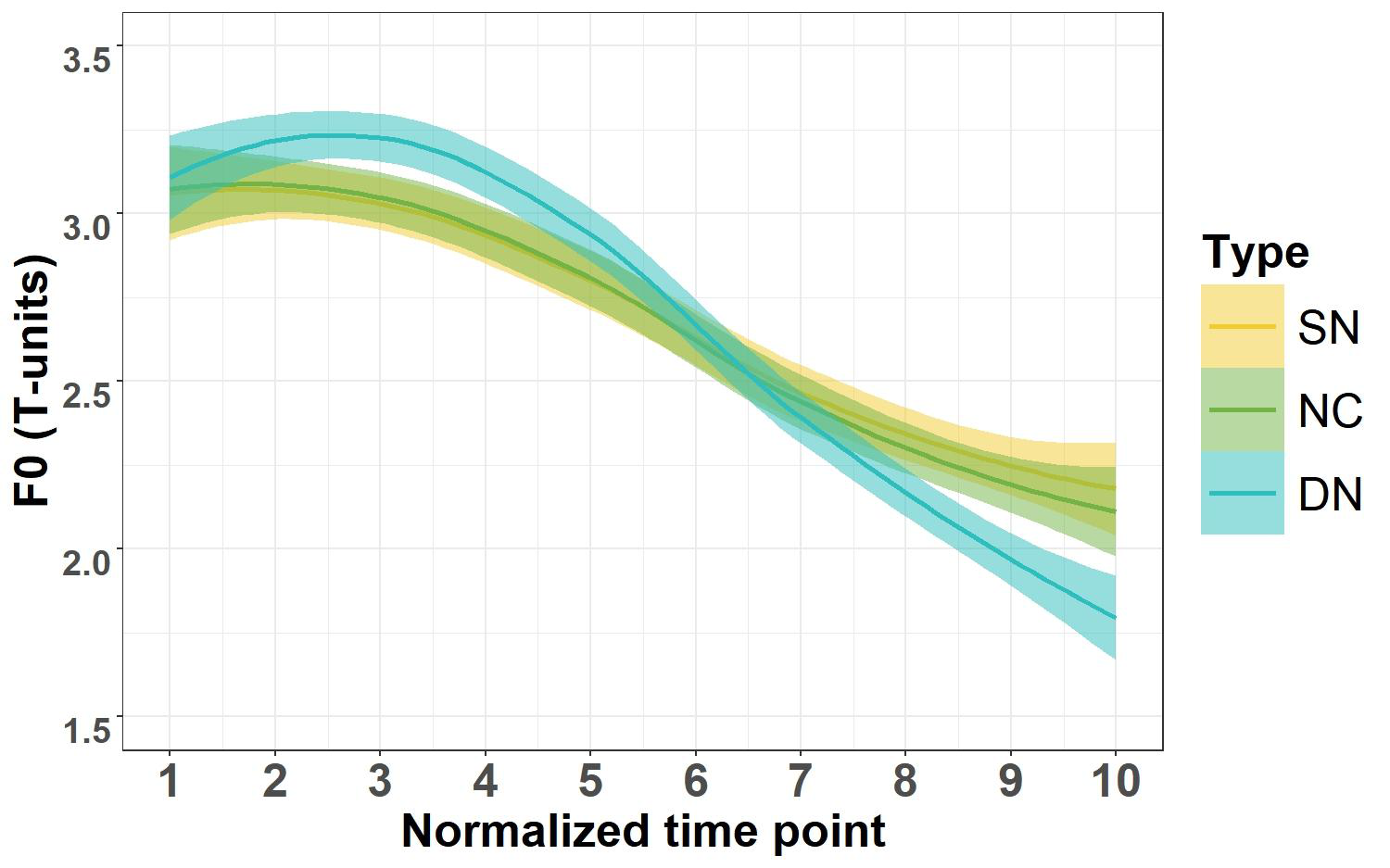
The time-normalized F0 contours of SN, NC, and DN are shown in Figure 10. All three contours represent the falling fourth-tone word bu and are generally similar in overall trend, but differ in specific details. Treating SN as the default contour, NC almost completely overlaps with SN, whereas DN shows significant differences from SN in both the first and second halves: the DN contour is significantly higher than SN before normalized time point 5, after which the two contours coincide, and then DN falls significantly below SN after time point 7. The starting points of the three contours are roughly similar, but they undergo different changes, with SN and NC coinciding at the endpoint, while DN has a lower ending point than both. The broader F0 range of DN is observable only in the contour graph.
Figure 10. F0 contours of SN, NC, and DN for the Mandarin negative response word bu.
Discussion
Integrating the experimental findings back into the revised formal-pragmatic account, syntactic structure, presuppositional context, and lexical-semantic properties jointly determine which interpretations are contextually available for bu. Prosody constitutes an independent phonetic layer encoding pragmatic markedness. DN—the marked reading that rejects the presupposition carried by the negative question, operating on NegP—receives robust phonetic highlighting: expanded pitch range, lengthening, and elevated intensity. By contrast, NC operates mainly via grammatical-syntactic negative-concord licensing at the TP level, without extra prosodic prominence, behaving acoustically nearly identically to the baseline SN.
From a cross-linguistic perspective, the most robust and potentially universal cue is the manipulation of pitch: as reported for English, Spanish, and Catalan, the marked interpretation DN is associated with a wider F0 excursion and a more prominent pitch movement, suggesting that pitch modulation may constitute a general prosodic strategy for signaling pragmatic markedness across languages. However, the Mandarin data also reveal language-specific characteristics: in addition to F0 variation, duration and intensity significantly contribute to encoding the interpretational contrasts. Thus, while pitch appears to be a cross-linguistically shared cue for distinguishing marked negative responses, duration and intensity may play a more substantial role in Mandarin Chinese, reflecting language-specific strategies in the prosody–pragmatics interface.
Conclusion
This research series examines how prosodic patterns, primarily pitch, participate in conversational interpretation from an experimental-phonetic and formal-pragmatic perspective. The study of hao shows that Mandarin prioritizes F0 modulation to distinguish fine-grained stance types while deploying duration selectively to mark negative stance, revealing how pragmaticalized uses undergo phonological reduction. The study of bu shows that distinct pragmatic interpretations (SN, NC, DN) map onto distinct prosodic profiles, with the marked DN reading phonetically highlighted by expanded pitch range, lengthening, and elevated intensity. Together, these findings demonstrate that universal prosodic strategies for pragmatic markedness are filtered through language-specific phonetic-phonological systems, and that the prosody–pragmatics interface can be fruitfully studied by combining experimental phonetics with formal pragmatics.
Research · 02
Trill Consonants
Trills are a central object of phonetic research. My work focuses on the production and phonetic variation of trills in languages such as the Tongtai dialects, exploring their articulatory mechanisms and patterns of variation.
Trill production in the Tongtai dialects is highly unstable: trills tend to occur after low vowels and show clear intergenerational and gender differences. This variation suggests that trill realization is jointly shaped by phonetic context and social factors.
Methodologically, I use Bayesian modeling and generalized additive mixed models (GAMMs) to disentangle the joint effects of multiple factors (phonetic context, age, gender, etc.) on trill realization, with Praat, Python, and R for acoustic analysis and data modeling.